
How to Size Your Off-Grid Solar System in the Philippines
Learn how to calculate the right solar system size for your home. Step-by-step guide using Philippine sun hours and real appliance wattages.
Why Sizing Matters
The most common mistake in DIY solar is buying panels before calculating your actual power needs. You end up with a system that can't run your appliances — or one that's way oversized for your budget.
This guide walks you through the sizing process step by step, using Philippine-specific data. If you are also weighing whether to grid-tie or stay off-grid, see our Meralco solar guide for that decision.
Step 1: List Your Appliances
Start by listing every appliance you want to power with solar. For each one, note:
- Wattage (check the label or manual)
- Hours of use per day
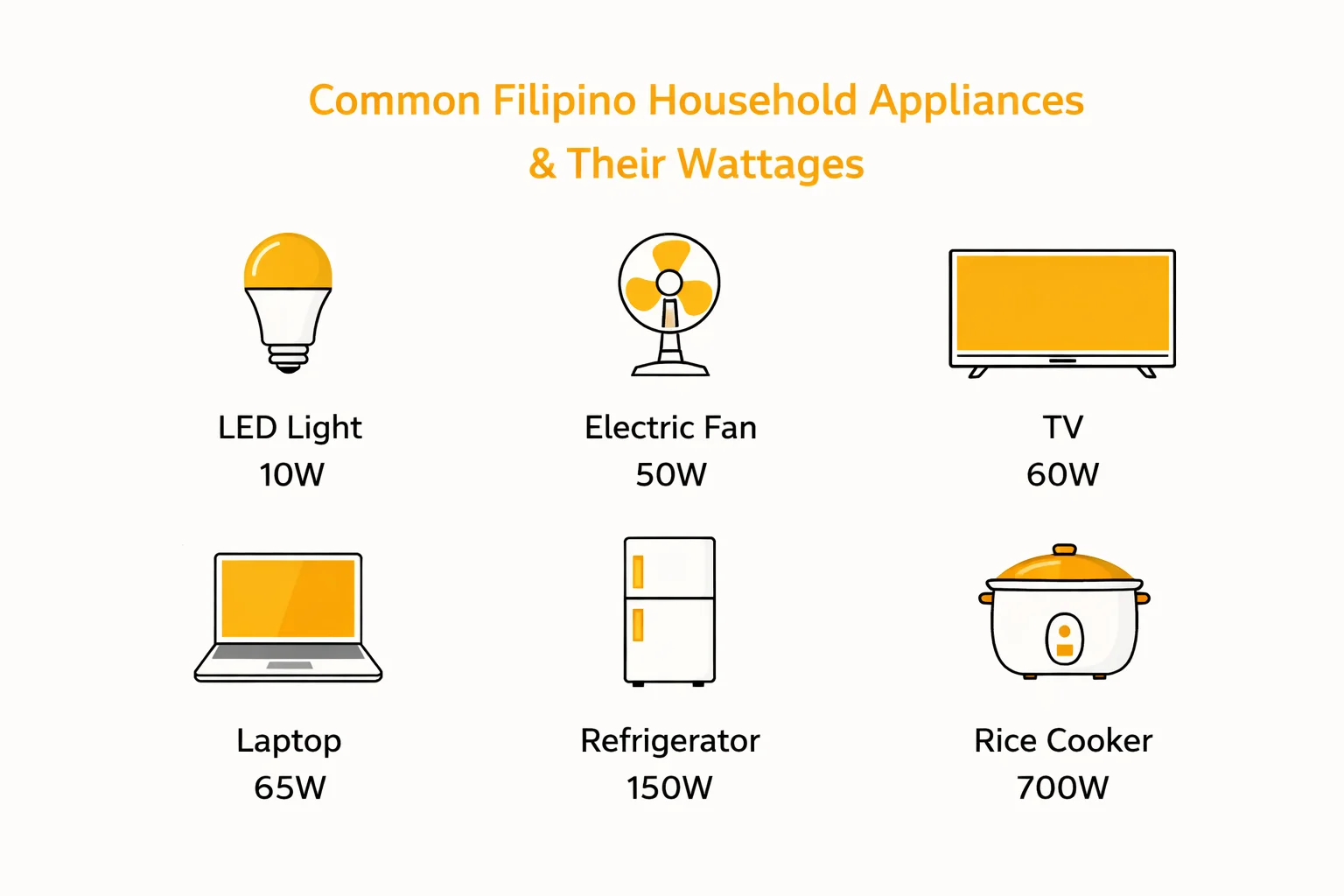
Here are common Filipino household appliances and their typical wattages:
- LED Light: 10W
- Electric Fan: 50W
- Ceiling Fan: 75W
- TV 32": 60W
- Laptop: 65W
- Phone Charger: 10W
- WiFi Router: 12W
- Refrigerator: 150W (runs ~8 hours/day on average)
- Rice Cooker: 700W (typically 30 minutes/day)
Step 2: Calculate Daily Energy Use
Multiply each appliance's wattage by its hours of use, then add them all up:
Daily Energy (Wh) = Watts x Hours x Quantity
Example for a typical Filipino household:
- 5 LED lights x 10W x 6 hrs = 300 Wh
- 2 electric fans x 50W x 10 hrs = 1,000 Wh
- 1 TV x 60W x 5 hrs = 300 Wh
- 1 laptop x 65W x 4 hrs = 260 Wh
- 2 phone chargers x 10W x 3 hrs = 60 Wh
- 1 WiFi router x 12W x 24 hrs = 288 Wh
Total: 2,208 Wh/day (about 2.2 kWh/day)
You can use our appliance-based DIY Builder to do this automatically — pick the appliances you want to power, set hours of use, and it sums daily Wh for you. For a hardware-cost ballpark by system size, see the 2026 Philippine solar price breakdown.
Step 3: Calculate Panel Wattage
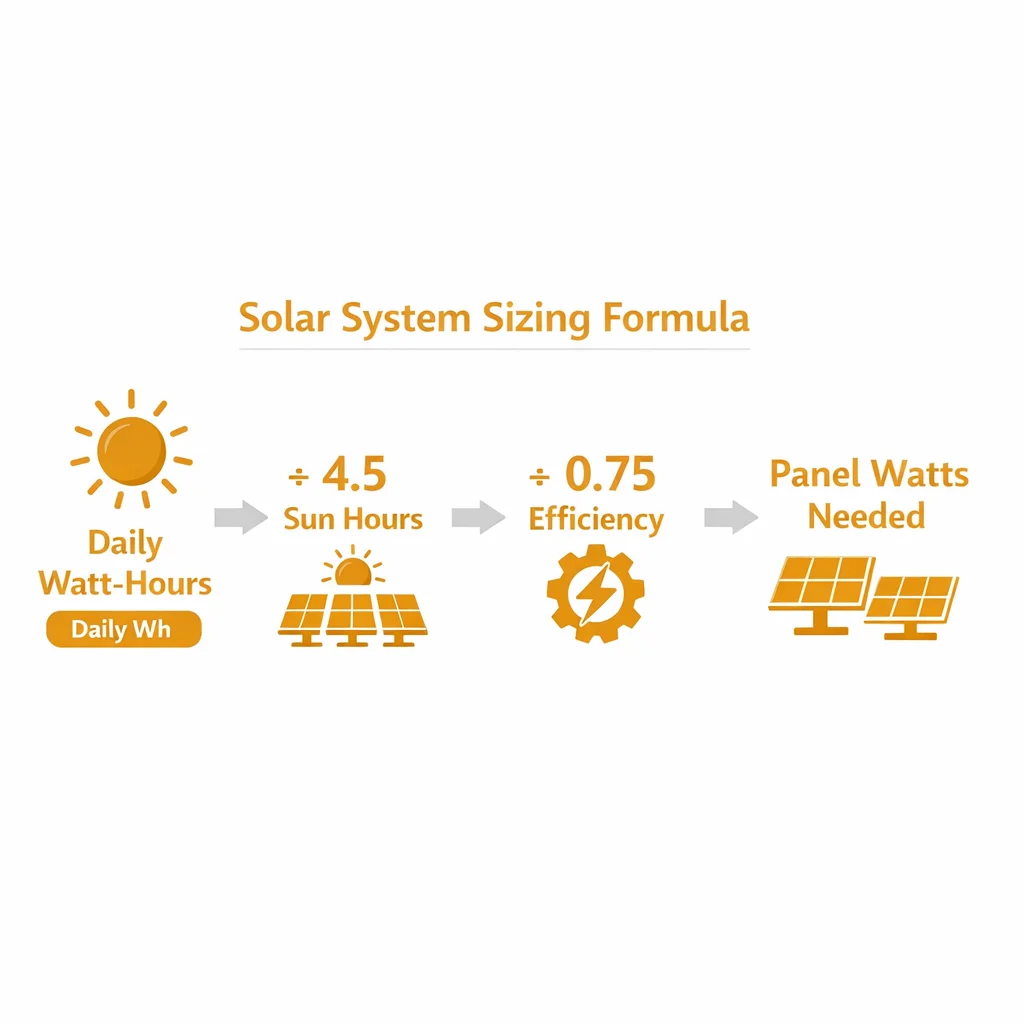
The Philippines gets an average of 4.5 peak sun hours per day. This varies by region — Manila gets about 4.2, Cebu about 4.8, and Davao about 5.0.
Factor in system losses (wiring, controller, battery charging efficiency) — typically about 25%:
Panel Wattage = Daily Wh / Peak Sun Hours / 0.75
For our example:
- 2,208 Wh / 4.5 hours / 0.75 = 654W of panels
Round up to the nearest available panel size. You'd need about 3x 200W panels or 2x 300W panels.
Step 4: Calculate Battery Capacity
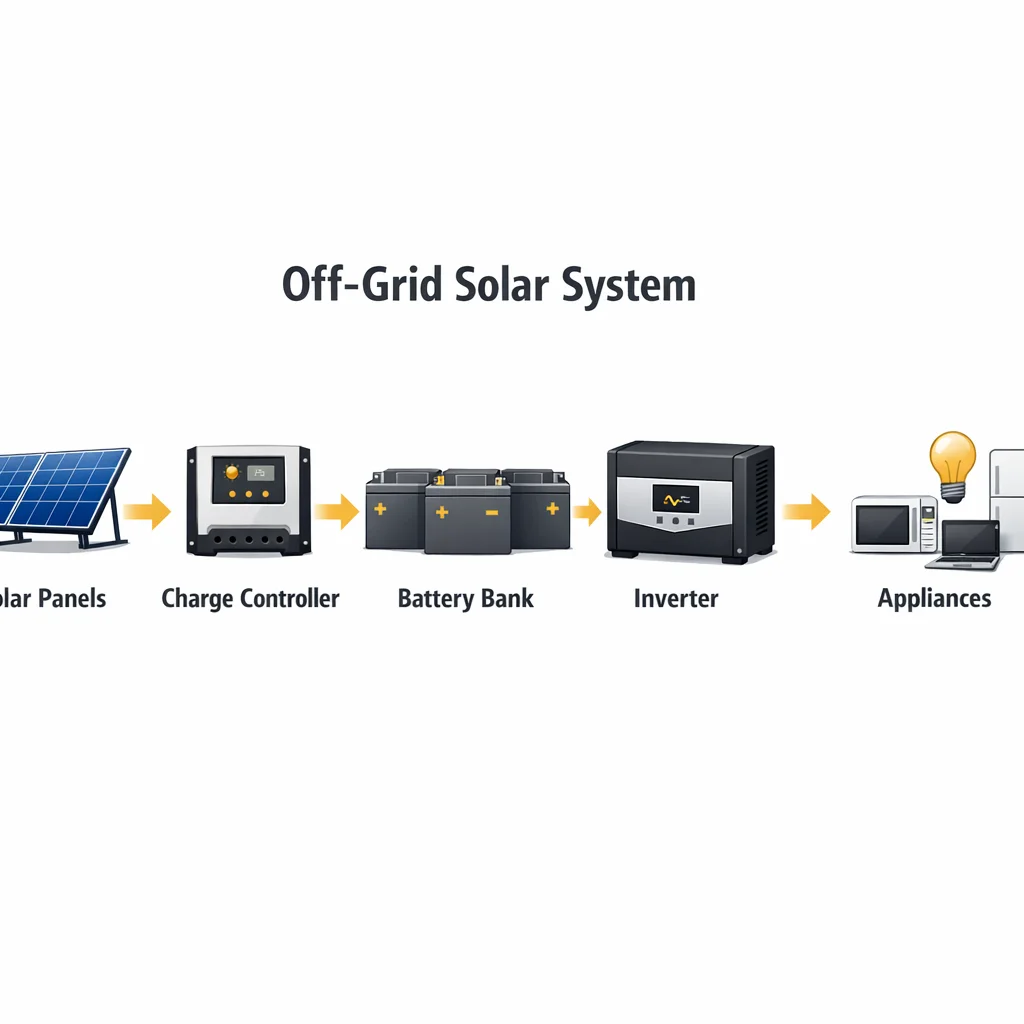
For off-grid, you need enough battery to store your daily use plus some reserve for cloudy days.
Battery Capacity (Ah) = Daily Wh x Days of Autonomy / Battery Voltage / Depth of Discharge
- Days of Autonomy: 1 day for mostly sunny areas, 2 days recommended, 3 for rainy areas
- Depth of Discharge (DoD): 50% for lead-acid, 80% for LiFePO4
- Battery Voltage: 12V for small systems, 24V for 1-3kW, 48V for larger
For our example (12V system, LiFePO4, 1 day autonomy):
- 2,208 Wh x 1 / 12V / 0.80 = 230 Ah
You'd need about 2x 120Ah LiFePO4 batteries or 1x 200Ah + some headroom.
Step 5: Size Your Inverter
Your inverter needs to handle the peak load — all appliances that might run simultaneously.
Inverter Size = Peak Watts x 1.25 safety margin
If your peak load is 500W (fans + lights + TV + laptop running at once):
- 500W x 1.25 = 625W inverter minimum
A 1000W pure sine wave inverter gives comfortable headroom.
Step 6: Size Your Charge Controller
Controller Amps = Panel Wattage / System Voltage x 1.25
For our example:
- 654W / 12V x 1.25 = 68A
You'd need a 60A or 80A charge controller. MPPT is recommended for systems above 400W.
Use Our Free Calculator
Don't want to do the math manually? Use the appliance-based DIY Builder — select your appliances, set hours, and get instant sizing recommendations. Then head to the parts browser to browse compatible components with real Philippine prices, and check our Meralco solar guide before deciding between off-grid, hybrid, and grid-tie.
Ready to plan your solar setup?
Use our free calculator to size your system and browse real products.