
Solar Panel Price Philippines 2026: Real DIY Cost Breakdown
Honest 2026 pricing for panels, inverters, batteries, and controllers in the Philippines — plus what an actual DIY system costs vs. a fully installed one.
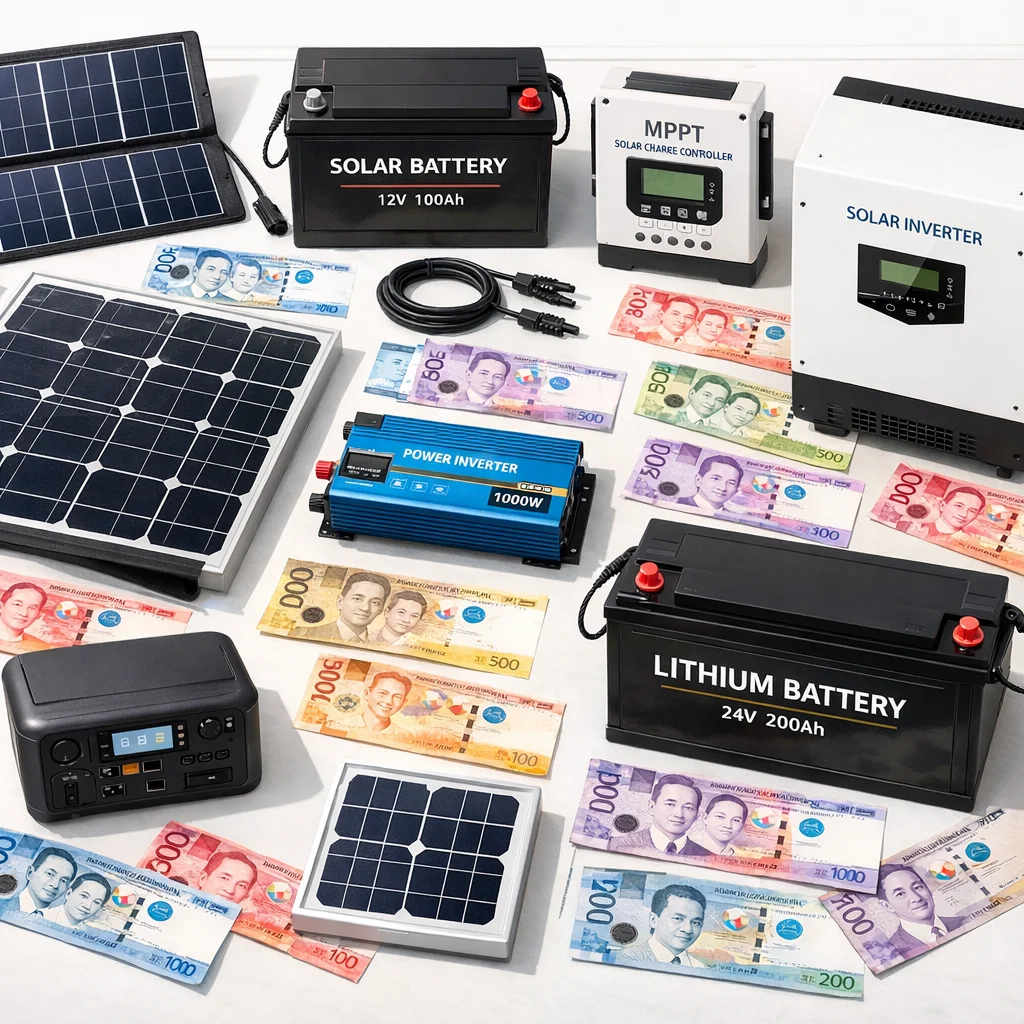
This article was generated with AI assistance and may contain inaccuracies. Data and prices mentioned were researched at the time of writing and may have changed. Always verify information from official sources before making purchase or installation decisions.
Magkano ba talaga ang solar setup sa Philippines ngayong 2026?
The first question in every Filipino solar Facebook group is always "magkano?" — and the honest answer is "it depends on whether you're buying panels or buying a finished project." This guide breaks down the real 2026 numbers for DIY builders: what each component actually costs, what a realistic setup totals out to, and where the markups hide when you compare DIY to a full installation.
Price drop context matters first. Installed solar has fallen to P55-P75 per watt in 2026, down from P80-P90 in 2024 — a 20-30% correction in two years (LakaSolar, 2026 Cost Guide). For a 5 kW residential system, that means fully installed prices now run P230,000-P391,000 depending on tier and location (pinas.solar, updated April 11, 2026). Metro Manila runs about 10-15% higher than provincial installs because of labor costs.
But installed prices include the markup. The actual hardware — panels, inverter, battery, controller, wiring — only accounts for roughly 50-60% of a typical installer quote (LakaSolar, 2026). The rest is engineering, permits, labor, and margin. That 40-50% gap is exactly what a DIY builder keeps.
Solar panel prices in 2026
Let us start with the modules themselves, because this is where the biggest confusion lives.
Tier 1 N-Type (Jinko, LONGi — 550W and up): P9,600-P14,400 per panel, or roughly P17-P26 per watt at retail (pinas.solar, 2026). These are the newest generation — higher efficiency, better low-light performance, longer warranty. Overkill for most DIY builds unless you have limited roof space.
Tier 1 PERC (Jinko, JA Solar, LONGi — 400-450W): P6,500-P11,000 per panel (pinas.solar, 2026). This is the sweet spot for most Filipino DIY builds — proven technology, still-strong 25-year performance warranties, and noticeably cheaper per watt.
No-name panels from Lazada or Shopee: You can find 400W panels at P4,500-P6,000 range, but verification matters. Some sellers ship genuine B-grade panels with minor cosmetic issues (fine for DIY), others ship rebranded panels with inflated wattage claims. If you go this route, test output with a multimeter before mounting — a 400W-rated panel that actually puts out 320W under ideal conditions is a 20% hidden tax on your system.
What this translates to at the system level: a 1 kW array (say 2x 500W panels) costs P12,000-P22,000 in Tier 1 hardware. A 3 kW array (6x 500W) costs P36,000-P66,000. A 5 kW array runs P60,000-P110,000.
Inverter prices: hybrid is the sweet spot for PH
Inverter choice is the second-biggest cost decision. Three main categories:
Pure off-grid inverters (3-5 kW): P15,000-P40,000 depending on brand. Cheapest option, but you cannot connect to Meralco at all.
Grid-tie only inverters (5 kW): P36,000-P54,000 (pinas.solar, 2026). These sell power back to the grid but shut down during brownouts — which is a dealbreaker for most PH areas.
Hybrid inverters (5 kW — Deye, Growatt, Voltronic): P68,000-P102,000 (pinas.solar, 2026). These handle grid-tie, off-grid, and battery backup in one unit. During a brownout, your solar and battery keep the house running — which is why hybrid is the dominant choice for Filipino DIY builds.
Deye 5 kW hybrid inverters are widely available through local retailers like JFL Solar and ABC Solar Electronics, and international sellers ship to Luzon through Lazada and Shopee. Growatt MOD 3000TL3-HU and 5000TL3-HU are the most common Growatt hybrid options for single-phase residential use.
Battery prices: this is where your budget decisions happen
Batteries are the single most expensive component in most DIY hybrid or off-grid builds. They are also where you have the most flexibility.
LiFePO4 is now the default for DIY. Lead-acid is cheaper upfront but the total cost of ownership math no longer works when LiFePO4 lasts 5-10x longer.
Here is what the Philippine market actually looks like in April 2026:
- 12V 100Ah LiFePO4 (good for small 12V systems or parallel builds): P12,500-P16,500 depending on brand. LvtopSun 12V 100Ah is around P13,500, LVFU 12V 100Ah around P16,500 (coolithium.com).
- 12V 200Ah LiFePO4: LVFU 12V 200Ah around P28,500 (coolithium.com).
- 48V (51.2V) 100Ah LiFePO4: LVTOPSUN around P42,000 (coolithium.com). This is entry-level server-rack battery territory.
- 48V (51.2V) 200Ah LiFePO4: P69,000-P114,000 depending on whether you get a rack-mount premium unit (LVFU rack at P114,000) or a standard build (LVTOPSUN at P69,000) (coolithium.com).
Installer-sold 5.12 kWh LFP systems: P108,000-P162,000 (pinas.solar, 2026). Compare that to DIYing a 48V/200Ah (10.24 kWh) LVTOPSUN at P69,000 — you get roughly 2x the capacity for less than the installer's single-battery price.
This is the biggest single reason Filipinos go DIY: battery markup on installed systems is enormous.
Charge controllers, wiring, and mounting
The remaining hardware is relatively cheap but matters for safety.
MPPT charge controllers (for non-hybrid builds): A quality 40A MPPT runs P6,100 retail, 30A at P5,400 (Shopee PH listings). Techfine, BOSCA, and SRNE are the common brands on Lazada. For systems above 150W, MPPT is worth the upgrade over PWM. For hybrid inverter builds, you do not need a separate controller — it is built in.
Wiring: Solar-rated PV wire (10 AWG) runs roughly P100-P150 per meter at retail. Battery cables (4 AWG or 2 AWG) are thicker and more expensive, P200-P400 per meter depending on gauge. Budget P3,000-P8,000 for a typical residential run.
Mounting rails and clamps: For a 3-5 kW system, expect P15,000-P30,000 in aluminum rails, L-feet, end clamps, and mid clamps. This is another spot where installers mark up heavily — you can source the same components directly from distributors.
What a DIY build actually totals out to in 2026
Here are realistic DIY totals by system size, using verified 2026 prices and assuming you buy hardware yourself:
Starter 1 kW off-grid (lights, fans, phone charging, small TV):
- 2x 500W Tier 1 PERC panels: P13,000-P22,000
- Hybrid inverter 3 kW: P40,000-P60,000
- 12V 200Ah LiFePO4: P28,500
- Wiring + mounting + misc: P10,000-P15,000
- Total: roughly P91,500-P125,500
Mid-range 3 kW hybrid (fridge, fans, lights, TV, laptops):
- 6x 500W Tier 1 PERC panels: P40,000-P60,000
- Hybrid inverter 5 kW: P68,000-P102,000
- 48V 100Ah LiFePO4: P42,000
- Wiring + mounting + misc: P20,000-P30,000
- Total: roughly P170,000-P234,000
Larger 5 kW hybrid (aircon capable, whole-house partial offset):
- 10x 500W Tier 1 PERC panels: P65,000-P110,000
- Hybrid inverter 5 kW: P68,000-P102,000
- 48V 200Ah LiFePO4: P69,000-P114,000
- Wiring + mounting + misc: P25,000-P40,000
- Total: roughly P227,000-P366,000
Compare the 5 kW DIY total (P227K-P366K) against the fully installed 5 kW quote (P230K-P391K) and the gap is narrower than most people expect — because Tier 1 hardware costs what it costs. The savings come from skipping the installer markup on labor, permits, and design. If you are building hybrid off-grid (no grid-tie), you can do the whole project yourself legally. If you want grid-tie / net metering, you will still need a Professional Electrical Engineer to sign off — but you can supply the hardware yourself and pay the PEE only for the certification.
Where to buy in the Philippines
For DIY builders in 2026, the realistic sourcing channels are:
Lazada and Shopee: Widest selection, easiest to compare prices. Stick to sellers with 4.5+ star ratings and thousands of transactions. Check reviews for photos of actual product (not stock images). Best for panels, batteries, small components.
Raon area, Quiapo (Manila): Traditional local sourcing for wiring, breakers, DC disconnects, and fuses. Prices are negotiable. Good for parts you need today without shipping.
Specialized solar retailers (Solaric, Solar Minerals PH, Anak Araw, ABC Solar Electronics): More expensive than Lazada but genuine stock, warranty support, and technical advice. Worth it for hybrid inverters and premium batteries where counterfeit risk is real.
Direct from distributors: For bulk buys (10+ panels or 4+ batteries), contact local distributors of Jinko, LONGi, JA Solar, Deye, and Growatt directly. Prices can drop 15-20% below retail.
Price traps to avoid
A few things to watch for in the 2026 market:
P5,000 "solar generator kits" on Lazada. These are almost always junk — undersized panels, PWM controllers labeled as MPPT, sealed lead-acid batteries inside "lithium" casings. Skip them.
Panels with suspicious wattage-to-price ratios. If a "500W panel" costs P3,500 and the Tier 1 equivalent is P6,500, there is a reason. Usually it is a 350W panel sold as 500W, or a B-grade unit with hidden microfractures.
Hybrid inverters under P40,000. There are no real 5 kW hybrids at that price. If you see one, it is either a 1-2 kW unit mislabeled, or a pure off-grid inverter pretending to be hybrid.
Batteries without BMS specs. Any LiFePO4 battery you buy should publish the BMS rating, cycle count, and temperature protection. Sellers who refuse to share specs are hiding something.
The ROI math against the latest Meralco rate
As of April 2026, Meralco's residential rate is P14.3496/kWh (Rappler, April 10, 2026) — up from P13.17 in February. Every peso of rate increase makes your solar payback shorter. For a deeper dive on the rate trend, see our breakdown of the Meralco April 2026 rate hike.
For a 3 kW hybrid system producing roughly 12 kWh per day in Philippine conditions (using 4 peak sun hours and 75% efficiency), your annual generation is about 4,380 kWh. At P14.35/kWh, that is P62,853/year in avoided electricity cost.
- P170,000 DIY build / P62,853 annual savings = 2.7 year payback
- P250,000 installed build / P62,853 annual savings = 4.0 year payback
Both are faster than they were 18 months ago, and they get faster with every Meralco rate hike. The math works. Whether DIY makes sense for you depends on whether you are comfortable mounting panels on your own roof and running the wiring yourself — not whether the financials add up.
If you want to run these numbers for your own appliances and energy usage, our appliance-based DIY Builder handles the sizing math, the bill analyzer reads your Meralco bill and computes payback for three scenarios, and the parts browser lets you pick panels, batteries, inverter, and controller while checking compatibility. For step-by-step sizing math, see the off-grid sizing guide; for the grid-tie vs hybrid vs off-grid decision, the Meralco solar guide. No sign-up, no sales call. TaraSolarTayo does not sell any of the products mentioned in this post — we just help you run the math honestly.
Sources
- Solar Panel Price Philippines 2026: Complete Cost Guide — pinas.solar, updated April 11, 2026
- Solar Panel Prices Philippines 2026 Cost Guide — LakaSolar
- Top 5 Cheapest LiFePO4 Batteries in the Philippines — coolithium.com
- MPPT Solar Charge Controller listings — Shopee Philippines
- Peso depreciation pushes Meralco power rates up in April — Rappler, April 10, 2026
Disclaimer: This article was generated with AI assistance using publicly available data. TaraSolarTayo is not a store and does not sell or endorse any products. Prices and specifications are estimates and may not reflect current market conditions. Always verify with the actual seller and consult a licensed electrician for installation.
Ready to plan your solar setup?
Use our free calculator to size your system and browse real products.